
Tanja Kovačević, Ph.D.
Postdoctoral Researcher – Fusion Materials Computational Science
Lawrence Livermore National Laboratory
email: kovacevic1(at)llnl(dot)gov
I am a planetary scientist and theoretical materials physicist studying the behavior of matter at extreme pressures and temperatures. I recently completed my Ph.D. in Earth and Planetary Science at U.C. Berkeley, where I used first-principles molecular dynamics, thermodynamic integration, and equation-of-state modeling to investigate the properties of planetary materials and their implications for the interior structures of planets.
My research explored rock-ice mixing and phase equilibria in water-rich exoplanets, iron-nickel partitioning in terrestrial and super-Earth cores, and the connection between planetary magnetic fields and deep interior structure.
In addition to my research, I am dedicated to fostering student engagement and outreach in the field of planetary science. I welcome any inquiries about my research or the field in general and am happy to share my experiences as a first-generation college student and community college transfer.
Outside of my academic pursuits, I enjoy spending time knitting, reading, and practicing yoga.
Research
Predicting Dynamo Layer Depths in Jupiter and Saturn
How deep do the convecting layers that generate Jupiter and Saturn’s magnetic fields extend? Spacecraft such as Juno and Cassini provide two important windows into the processes occurring deep within these planets: the magnetic fields measured at their surfaces and their emitted intrinsic heat flux. Energy-based dynamo scaling laws relate magnetic field strength to the convective power and characteristic length scale of a dynamo. In our recent article, we invert these scaling laws to instead constrain that length scale, providing a way to estimate the depth of the dynamo-generating region of the gas giants that is consistent with observations.
To connect the scaling laws to Jupiter and Saturn, we translate their observable surface properties into the physical quantities that feed into the scaling laws. First, the observed intrinsic heat flux is combined with thermodynamic and gravity-constrained interior profiles to determine how convective power varies with depth. Then, spacecraft measurements are used to estimate the magnetic field associated with different possible dynamo boundaries. Together, these allow us to evaluate which dynamo layer geometries are consistent with the observed properties of each planet.
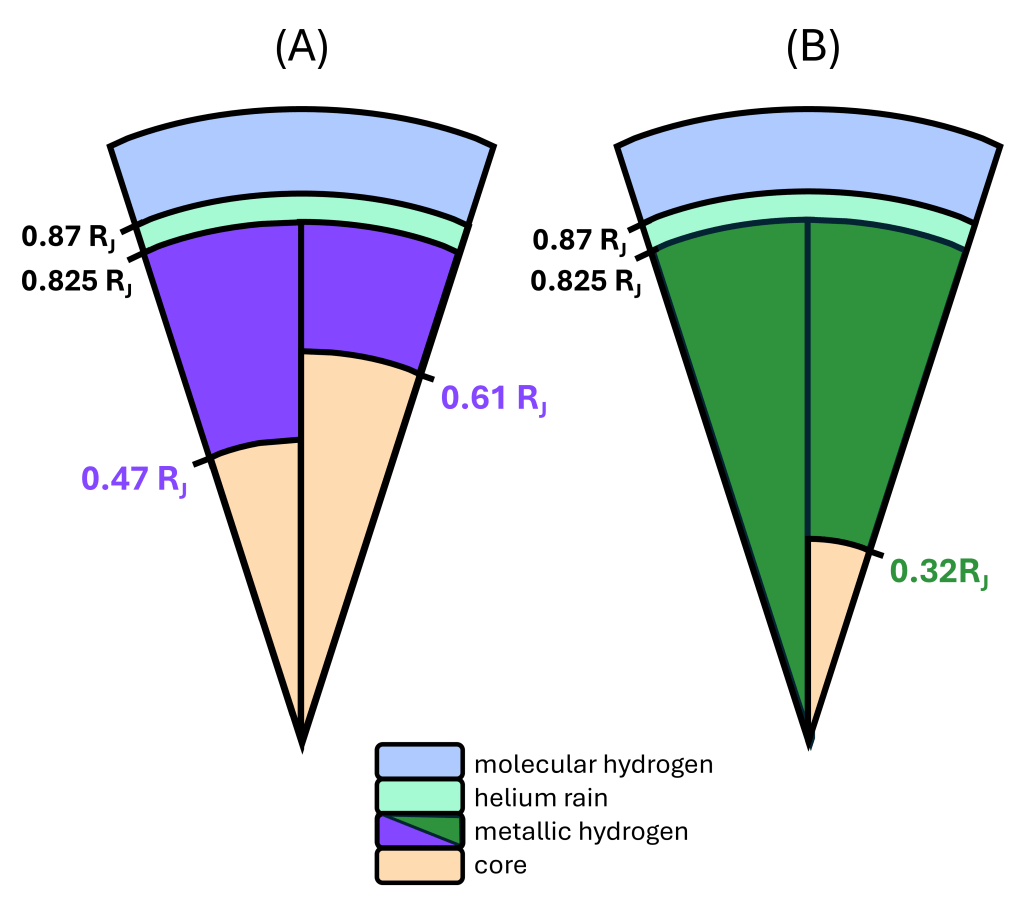
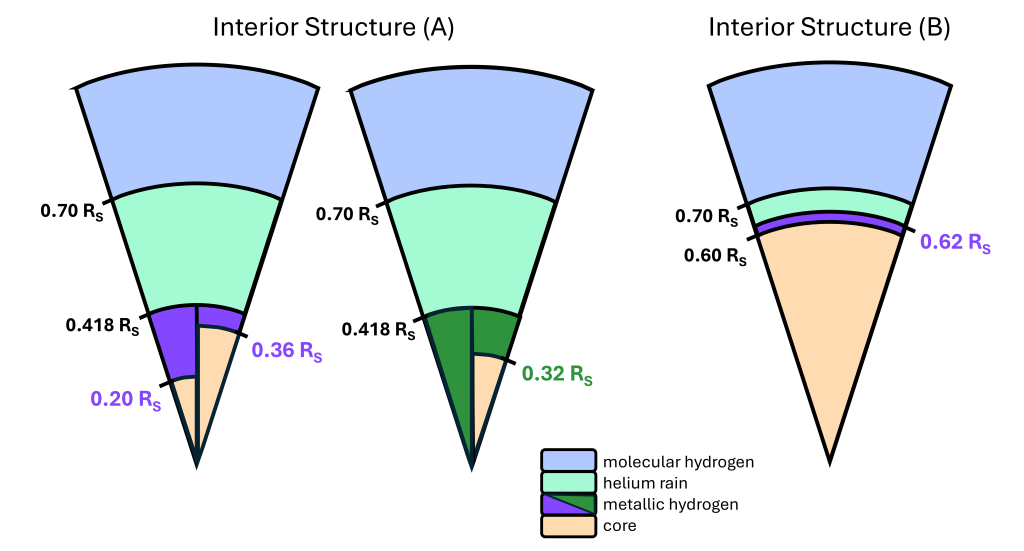
to the Lowes radius of 0.418 RS as in Yan et al 2021. The paired slices show the
thickest and thinnest dynamo layers predicted by the Davidson (purple) and Gastine (green) scalings. In panel ”B”, we instead fix the inner boundary to 0.6 RS, as inferred from ring seismology models of Mankovich et al 2021.
The Dynamic Mixing of MgO & H2O
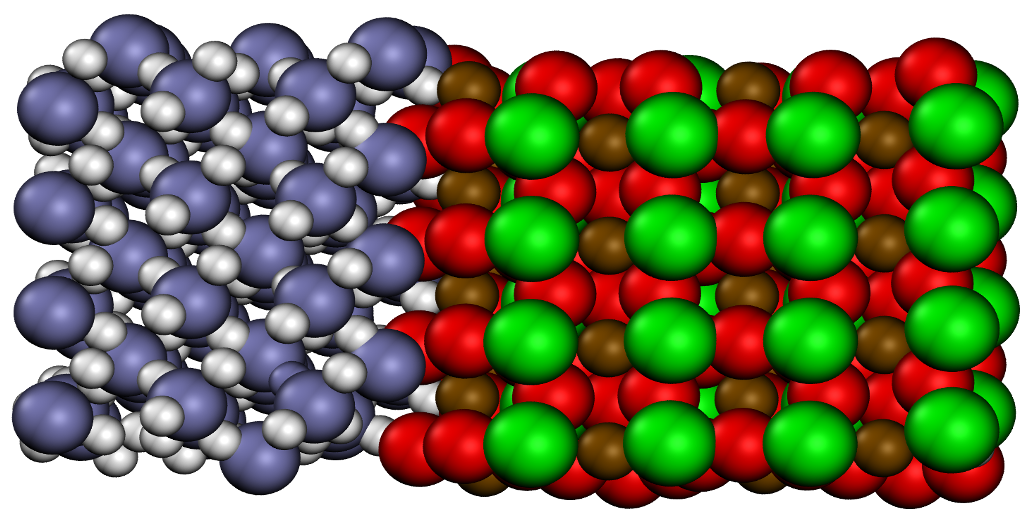
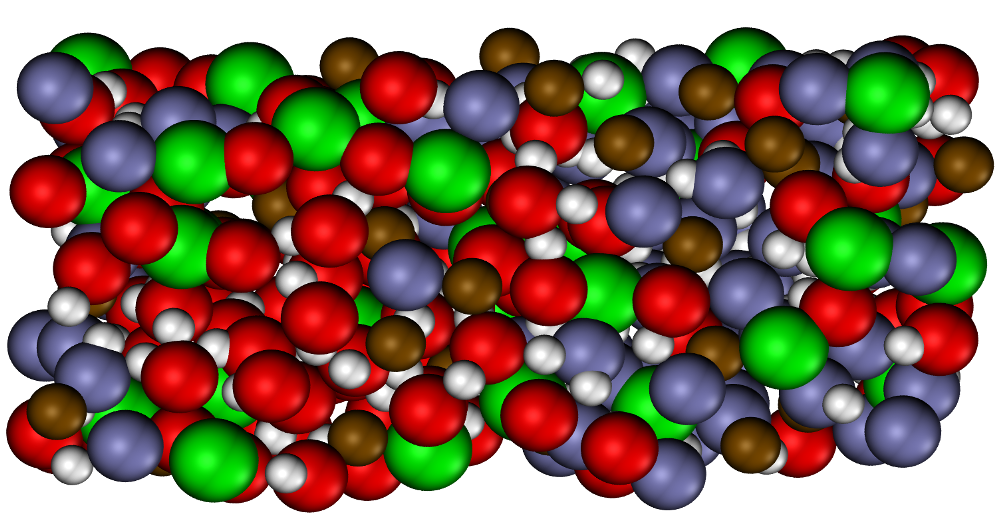
Investigating sub-Neptunes, exoplanets with a mass between Earth and Neptune, involves understanding their formation and evolution by examining their interior and constituent properties, especially those that may be water-rich. To shed light on the interaction between the rocky mantle and water-rich envelope, in this present article, we utilized density functional molecular dynamics simulations to explore the thermodynamic properties of MgO and H2O under extreme conditions. Employing a “heat-until-it-mixes” approach, we identified the pressure-temperature conditions at which rock and ice become fully miscible (the solvus point). Notably, we found that MgO and H2O mix well below MgO’s melt curve, which has significant implications for planetary evolution.These results support a hypothesis of compositional gradients within water-rich exoplanets, significantly influencing a planet’s evolution.


The Dynamic mixing of MgSiO3 & H2O
Water worlds are exoplanets more massive than Earth that contain a significant amount of water overlaying a rocky mantle and iron core. Characterizing the interactions between water and rock under the pressures and temperatures within water worlds is essential to understanding their structure, formation, and evolution. In this article, we studied the dynamics between water and high-pressure MgSiO3, a major silicate phase, and determined the conditions when they form a homogeneous mixture. We find that MgSiO3 and H2O become miscible at the conditions found within the interiors of water-rich exoplanets during their collisional growth, forming a fuzzy, mixed layer and increasing the amount of water incorporated deep within the planet. A mixed layer affects chemical evolution and heat transport through a planet.
Here is a video of me discussing our work: Youtube link.

Publications
- T. Kovacevic, D. Holdenried-Chernoff, B. Militzer, and B. Buffett, Constraining the Dynamo Layers in Jupiter and Saturn with Observations and Scaling Laws, The Astrophysical Journal 1002, 135 (2026). DOI:10.3847/1538-4357/ae5bc1
- T. Kovacevic, F. Gonzalez-Cataldo, B. Militzer, “The homogeneous mixing of MgO and H2O at extreme conditions“, Contrib. Plasma Phys. (2023) e202300017. DOI:10.1002/ctpp.202300017
- T. Kovacevic, F. Gonzalez-Cataldo, S. T. Stewart, B. Militzer, “Miscibility of rock and ice in the interiors of water worlds“, Scientific Reports 12 (2022) 13055. DOI:10.1038/s41598-022-16816-w
- T. Kovacevic, A. Skinner, J. Fisk, V. Fishback, S. Reed, “A semester-long, organic chemistry laboratory structured around unknown analysis and re-synthesis as a bridge to guided inquiry“, J. Chem. Ed. (2020) DOI: 10.1021/acs.jchemed.9b01037
 Tanja Kovačević, PhD